
There are some locations that do not insist you look at them; they insist you stand still.
The Botanical Garden of Ooty is one such location.
Somewhat begrudgingly you walk in, and before you notice what flowers, what trees, you notice the silence — a kind of silence that does not feel empty but full; like a prayer that never stops.
The air smells like damp soil, like tea, like life seeping into an attentioned piece of peace.
And somewhere between the heft of the wind and the call of a bird, you recognize that this place oozes; you do not just see nature here, you feel it.
Where Time Walks Slowly
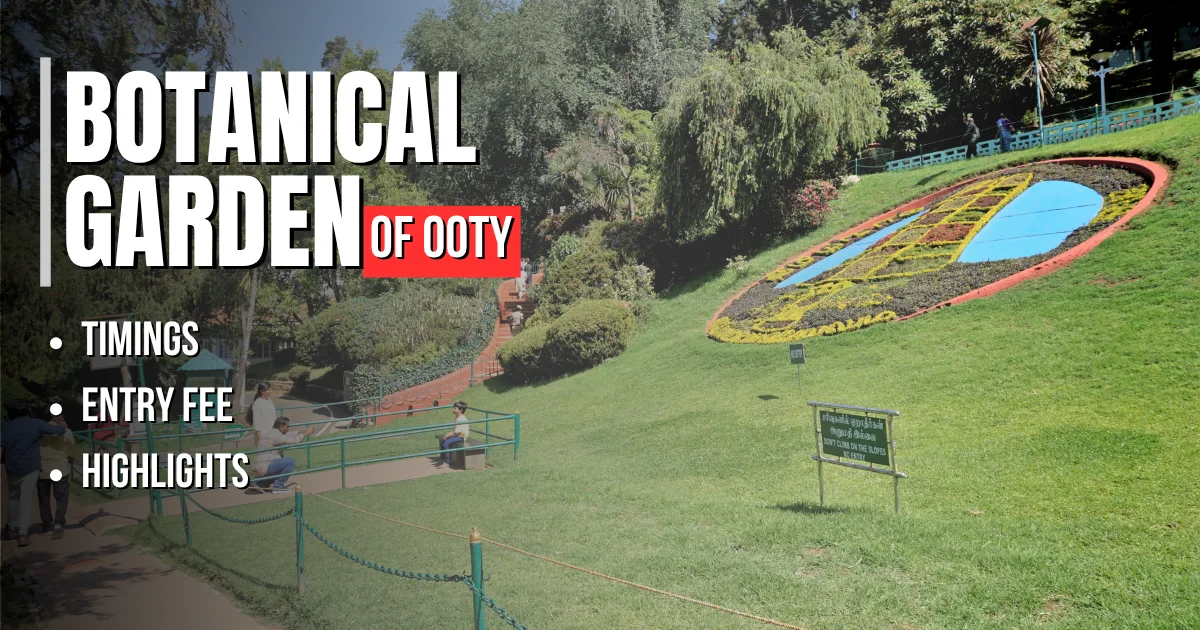
The Government Botanical Garden of Ooty rests quietly on the slope of the Nilgiri hills — fifty-five acres of calm, stitched together by small pathways, terraces, and lawns that rise like gentle thoughts one after another.
There is no straight line here, only curves — as if the garden itself has learnt to move slowly with the mountain.
It was laid out long ago, in 1848, by a man named William Graham McIvor — a Scottish horticulturist who must have understood what patience means, for you can see it in every inch of this place.
The British may have built it, but it belongs to the mountains now — to the mist that comes uninvited, to the flowers that bloom without reason, to the people who walk here and forget to speak.
The Botanical Garden of Ooty is divided into sections — the Lower Garden, the Italian Garden, the New Garden, the Conservatory, and the Nursery — but to walk through them is to forget names.
The same quiet rhythm everywhere: footsteps, wind in leaves, light filtering down through the trees like something sacred.
And there it is, amidst all that life, fossilized in place: a tree turned to stone over twenty million years ago.
It stands in a kind of silence, as if it is standing guard over all that has stayed the same and all that has changed.
The Soul of the Garden
Every kind of flower can be found here — roses, dahlias, marigolds, lilies — and not one of them cries out.
They grow amicably as if they themselves understand how beauty doesn’t need to announce itself.
You see couples sitting beneath the tall trees, with children running around with half-eaten ice creams, and old men slouched over their benches as if the world has finally slowed down enough for them to breathe.
The Botanical Garden of Ooty is not made to impress. It is made to remind — that even in a hurried world, stillness can exist.
Ooty Botanical Gardens Timings and Entry Fee
The garden opens when the sun begins its slow rise and closes when it begins to rest.
Ooty Botanical Gardens Timings:
Monday to Sunday – 7:00 am to 6:30 pm
Ooty Botanical Gardens Entry Fee:
₹100 for Adults, ₹50 for Children, ₹50 for Still Camera, and ₹100 for Video Camera.
Simple numbers for a place that gives back more than one can count.
Come early, when the grass still holds the morning dew, or come before evening, when the golden light bends through the trees — either way, you will find peace waiting.
What You’ll See When You Stop Looking
To see this garden properly, you must forget your camera for a while.
Sit on the grass. Watch the light move.
Somewhere a gardener waters the plants with the same care he would give to his own child. Somewhere a leaf falls, soundless. Somewhere a bird calls and the mountains answer.
This is not sightseeing. This is remembering.
Famous Tourist Attractions Near Ooty Botanical Garden
Just beyond the gate, Ooty continues its quiet story.
The Ooty Lake lies nearby, still and patient, holding reflections of passing clouds.
The Rose Garden, bright and fragrant, feels like the garden’s younger sister — playful and proud.
The Tea Factory hums with the scent of roasted leaves, while Doddabetta Peak, the highest point in the Nilgiris, waits silently above, watching everything below.
All these together form the heart of Ooty — a place that does not rush you, but gently teaches you how to slow down.
History and Main Attractions of Ooty Botanical Garden
In every corner, you feel the hand of history.
This garden began as a colonial dream but has become a part of India’s living memory.
Each terrace is a step through time — from British precision to Indian patience.
The Italian Garden lies arranged like art; the Fern House holds delicate green species that look older than language; the Conservatory glows with orchids that open only when they wish to.
And yet, beyond all its names and designs, what remains is its mood — a quiet dialogue between man and mountain.
The Botanical Garden of Ooty is not proud of its age; it is content with its grace.
Best Time to Visit Botanical Garden of Ooty
The hills wear different moods in different seasons, and each has its own charm.
From March to June, the flowers bloom as if in festival; in May, the famous Ooty Flower Show paints the slopes in a thousand colours.
During monsoon, the rain polishes every leaf till it shines; in winter, the mist lingers longer, and the mornings arrive late, soft and silver.
But whenever you come, you will find the same peace — waiting in the grass, in the wind, in the way silence curls around the heart.
Ooty Botanical Gardens Address
Nilgiris, Vannarapettai, Ooty, Tamil Nadu, 643002, India
Why Travel with Ooty Tourism
Because we believe that travel is not about places — it is about feelings.
We do not hurry you through the garden; we let you walk as you wish, rest where you like, and see as your heart wants to.
At Ooty Tourism, we take care of details so small that you never have to think about them — tickets, timing, routes — leaving you free to simply exist inside the beauty you came to find.
Because in a place like the Botanical Garden of Ooty, planning disappears, and only presence remains.
FAQs – Botanical Garden of Ooty
1. What are the opening hours of the Botanical Garden of Ooty?
It opens daily from 7:00 am to 6:30 pm.
2. What is the entry fee?
₹100 for adults, ₹50 for children, ₹50 for still camera, ₹100 for video camera.
3. Who designed the garden?
William Graham McIvor, in 1848.
4. What are the main attractions inside?
The Italian Garden, Fern House, Orchid House, and a fossil tree over 20 million years old.
5. When is the best time to visit?
Between March and June, especially during the Ooty Flower Show in May.
6. Are cameras allowed?
Yes, with a small additional fee.
7. What can families do inside the garden?
Walk, rest, take photographs, or simply enjoy nature’s calm — it’s safe and peaceful for all ages.
8. What places are near the garden?
Ooty Lake, Rose Garden, Doddabetta Peak, Tea Factory, and Coonoor.
9. How big is the garden?
It spreads across 55 acres on the Nilgiri slopes.
10. Why visit with Ooty Tourism?
Because we take you beyond the itinerary — into the quiet heart of the garden itself.
In the End
When you step out of the Botanical Garden of Ooty, you don’t really leave it behind.
Something of it follows — the smell of the grass, the sound of leaves, the feeling that the world, too, can be gentle.
You carry it in your breath, in your steps, in the silence that grows inside you after.
And that is the beauty of Ooty — it never asks you to remember it; it simply refuses to be forgotten.